




Immersion cooling submerges computer hardware, such as servers and Bitcoin miners, directly in a non-conductive dielectric fluid to remove heat more efficiently than air. The fluid absorbs heat through direct contact, eliminating the need for fans, air conditioning, or raised floors. This enables much higher power density by allowing equipment to run at full capacity without thermal throttling. It also reduces energy consumption, noise, and infrastructure costs in data centers and mining facilities.
The Future is
Immersion Cooling
This is an increasingly popular means of cooling computing equipment by submerging them in a non-conductive liquid
What is immersion cooling?
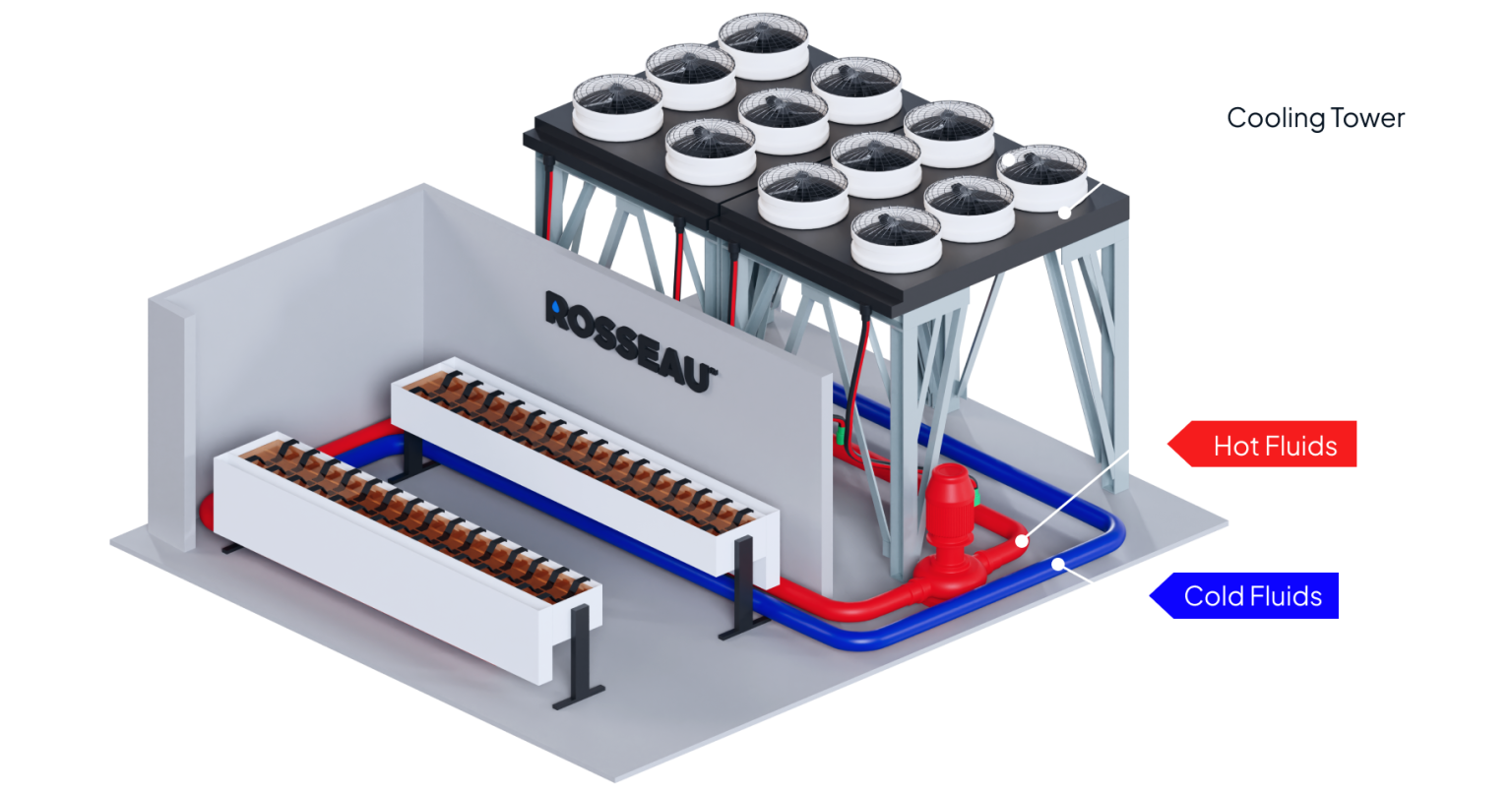
How does Rosseau achieve Industry leading Power Density?
Single-Phase Dielectric Fluid Immersion
Servers and miners are fully submerged in a non-conductive fluid that provides direct, uniform heat extraction, allowing operation at over 8,500W per unit without hotspots. This eliminates air cooling limitations, enabling double the power density (e.g., 400-425 TH/s from a single WhatsMiner M66S) in the same footprint
Custom High-Efficiency Heat Exchangers
Tailored partnerships, like with Kelvion, deliver specialized dry-cooler systems optimized for extreme thermal loads. These handle industrial-scale densities (up to 100 kW+ per rack) with minimal energy overhead, ensuring reliable cooling that scales power output without expanding infrastructure.
Modular, Dense Rack Configurations
Rosseau’s plug-and-play tanks support ultra-tight hardware packing—up to 2x more ASICs per square foot—while maintaining airflow-free operation. This design maximizes hashrate per facility space, ideal for 200MW+ mining sites, reducing capex and boosting ROI through superior density.
Sustained High-Load Performance
Advanced fluid dynamics and monitoring enable continuous 24/7 operation at peak power, far surpassing legacy systems’ derating needs. By whisking away heat 10x faster than air, it unlocks untapped miner potential, achieving industry-leading efficiency and density for future-proof HPC deployments.